

I loved my holidays. They were the only times I cared about, to be brutally honest. They were also the only time we were all together. The kids were growing older, now both teenagers, just about coping with us as parents when their worlds were expanding. Zyle, my eldest was about to finish her training in genetic engineering and Han would soon be serving his national service. This could well be our last summer holiday together, I knew that, as did my long-suffering wife, Georgia – who was trying not to be over-emotional about it. She was working, like me, for most of pretty much every day to serve the community. This was so rare and beautiful, to be doing something, frankly doing anything else than the usual hellish, drab routines.
Being married was more than a necessity, more than a law. We would glance at each other sideways in the front seats of the shell buggy, smiling inanely. For once, the lines on her forehead were not creasing with anxiety, she wasn’t biting her lip or pinching her fingers. Similarly, this was more than a holiday, it was a recharge, a levelling, a balancing out. It was a time to do what we wanted, not what we were told to do by the authorities.
I loved driving our little rented vehicle as we rarely got to use it, living most of the year underground in The Hive, a tunnelled complex with city parks and offices and artificial sunlight that never truly met the brief, in our minds anyway. You can’t fake the outside convincingly.
Our buggy was the business. It had a climate-controlled cabin, its own water recycler, a family gun rack, sleeping bunks, and a tiny if impersonal bathroom in the back that could cope with a family of four for a week.
“I can’t believe it’s been a whole year since we have seen the sea!” I nearly shouted, and Georgia nodded and raised her pencil thin but expressive eyebrows. She looked so radiant now we were free for a short while. I really did love the holidays.
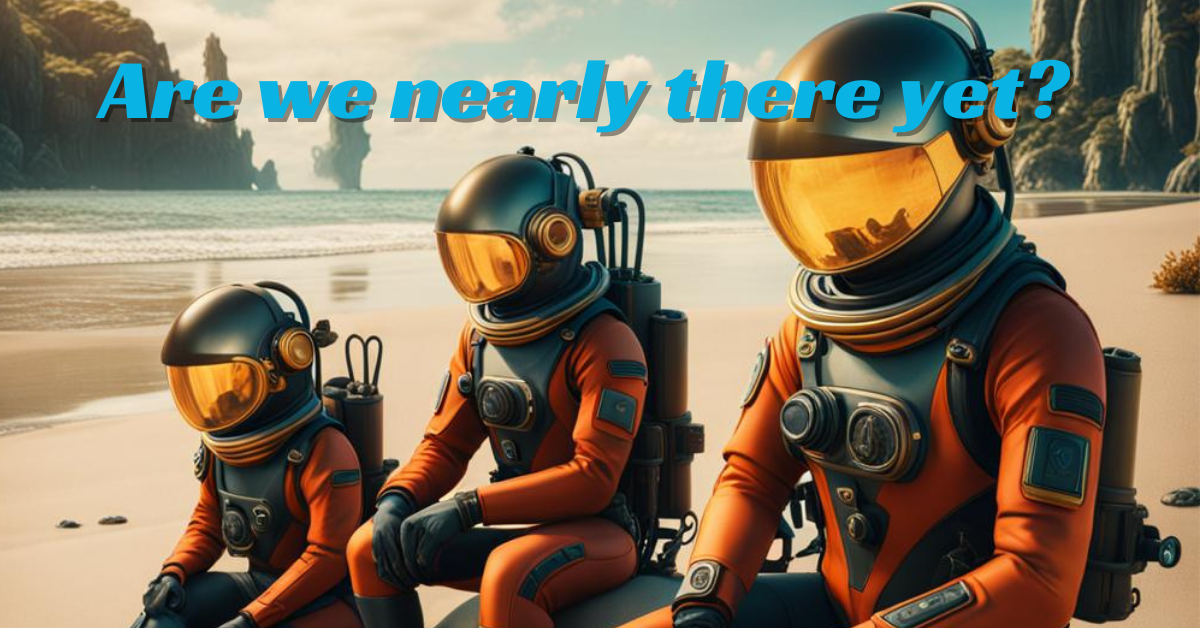
“Are we nearly there yet?” said Zyle. Her white-dyed hair reminded me that she was conservative in her ways, a child of the 2050s. It was the fourth time she had asked.
“Yes, I can finally say we are”, I reassured her.
The road was rugged, uneven and dusty. Large black insects were impacting the windscreen in their dozens, leaving sludgy green smears across my view. They have been growing bigger every year since the Bio-Boost of 2030, when pollinators were bred in captivity in their millions as an emergency measure. There were ominous dark clouds in the sky, huge, towering anvils bearing down on us. It was not unexpected, but I hoped we would catch a break in the weather.
“I’m going to stop at the beach supermarket first. Let’s get that fun food shop for the holiday sorted!”
The buggy’s huge tough air-turgid wheels bounced over dead collapsed trees without consequence. The supermarket, called Lasties, was like a steel fortress from the outside, it had to be, to protect it from the menacing weather cycles.
We drove straight into the complex, with its massive sprawling umbrella-like roof and parking ramps, complete with wheel anchors.
Leaving the buggy was fun. We darted out to avoid the lashing winds that were picking up and buffeting our vehicle like it was a toy. Through the airlock, we were greeted by automatic messages and aisles of military-grade storage boxes, each labelled with an image of the food within them. A message repeated over speakers in the corners of the hanger-like space, ‘Take only what you need, don’t be greedy, we are monitoring you’. There were grapes and figs, and kelp-based products, all the drought-resistant foods that had become staples to survival. Other tourists were in there milling about, picking out choice items for their backpacks, but it wasn’t busy – it was early in the season after all. The rain began to hammer outside, it drummed upon the vast metal roof like an attack from nature.
Zyle had taken three packets of dried seaweed for herself, but it was permittable. We were here for a week and no one stopped her, so why not?
I noticed Han had his mind in his music, as heavy bass pumped into his brain from tiny chips under the skin of his ears. He must have activated it with a verbal password when he entered Lasties, marking an official start to his vacation. A single guard manned the help desk, but there were three greasy, well-worn, defender-class robots in case of thieves or marauders. The guard was almost asleep, slow breathing, lazy and bored, reading a story on his device through bi-focals, with his dirty, mud-splattered boots balanced on the counter irreverently.
We had half-filled our rucksacks when the rain began to harden to hailstones, at first like cold bullets but shortly after transfroming into fist sized ice-balls. The sounds were deafening. Han even turned off his music.
“Should we be worried?” asked Zyle.
“Maybe,” I whispered. “But the alarms will tell us if it’s a problem.”
As if fate was listening for my prompt, the weather damage alarm began to sound, an urgent booming repeater with red lights flickering on to reinforce the potency of the warning.
“Back to the buggy, now!”
The guard had scrambled to his feet, brushing crumbs off his shirt from a recently disintegrated snack. He decided to ignore the bewildered shoppers and the danger they might be in and instead save his skin by shirking swiftly to the boxy safety room – a doubly reinforced bunker near his desk.
The hailstones were growing to the size of footballs outside. Some were denting the roof of Lasties. We ran back to the buggy under the umbrella shielding and locked the door behind us. Out beyond the limits of the supermarket’s extended roof panels and steel ribs, there was an ice storm pummelling the landscape in full ferocity. I felt relief that we had not stopped en route – the buggy would have been beaten badly, caught out in the open without any cover. It would have been terrifying. Other shoppers were scattering and diving back to the safety of their parked vehicles. As quick as it had arrived, it was all over in seconds, melting white boulders now causing a new problem as the water pooled and rose around the giant wheels.
“Right, let’s get this thing moving.”
I checked the hull was watertight with the diagnostic panel and we lumbered out back to the short stretch of gritty track winding to the beach. A flood of icy water curled and jutted about the buggy, right up to the top of the wheels and I steered it away from the well-worn channel that met the edge of the beach, so we bounced onto the sodden plains of sand.
“We’re clear, and we have some snacks for lunch!” gleamed Georgia, completely unperturbed by the event. She was good at ignoring and brushing off dangers, it was her thing. She hated to be intimidated so decided at some point not to be.
There was always a challenge during a holiday, something that surprised us, a dab of peril because that was the truth of venturing outside. It was worth the risk, it was always worth the risk. I decided that if that was the only surprise we faced then all was looking grande for the rest of the trip. Luck would be on our side, I was certain. Being above ground was like a sacred time, a time to live beyond existing.
The shoreline was crowded with shell buggies just like ours. It looked exactly like a scene in one of those faded, weathered photographes of those old bathing machines of the 1800s, a crammed nest of vehicles clustered into the breakers, with bathers fully dressed in extravagant swimwear, dipping their toes into the water for a thrill.
I always imagined the scene of such machines, past or present, resembled a colony of animals huddling in the shallows, like marine moluscs gripping the ground in numbers for security.
I had weaved the buggy into a spot that had not been taken and waved to our new neighbours on either side jovially. On the right, there was an elderly couple, wearing tall hats and smoking some substance through pipes, and on the left a similar family of four like ours. Happy smiles surrounded us. I could feel the buzz of excitement. We were going bathing, what a blast!
“Everyone suit up, full checks please for acid protection and get your safety beacons activated. I want the helmets on before we open the door. Radiation can kill you on a bad day, you know that already from your Auntie Beth’s miscalculation!”
“Dad, you sound so strict! It doesn’t suit you,” laughed my son. Safety protocols were the only time I came close to raising my voice like that. I shot him a look and unravelled my thick dry suit, along with the diving helmet. The sea was lapping the sides of the buggy gently. I heard what I thought was a seabird, a solitary squawk, which was rare. I had to get out there and look. I had seen a ragged bloodied seagull once, twenty years ago, but I had assumed they were extinct by now.
I pushed the button for the door release and the metal side of the buggy swung upward obligingly. The water was a foot below the bottom step, these vehicles were high enough to avoid small waves coming into the living quarters. Georgia went first, carefully finding and exploring each tred before plopping into the sea up to her knees, giggling like she was ten years old. The steam was rising from the greenish surface but it was not too hot, due to the time of year – we were trying to beat the rush. I guessed it would feel like a hot bath and when I dropped in unceremoniously, I was right, making a few choice noises with the shock of heat and trying not to swear for the kids’ sake.
“Let’s keep it to five minutes for safety!” asserted Georgia, worried about the children’s tolerance.
“At last! A day at the beach!” I announced, smiling at the water which swirled and pushed me with a tidal nudge.
“Are there any animals at all, at this beach?” asked Zyle, “And bugs don’t count.”
“Maybe,” I said but I didn’t know. There wasn’t much information beyond the usual warnings on the beach’s website.
There were people in the sea near us. A few other tourists had dared take a dip, as opposed to sitting in their cradle-like car seats, blankly admiring the horizon. They moved slowly and looked like astronauts on a low-gravity planet in all that protective gear. I could hear them laughing in their helmets. It was fun to be out and in seawater. Amazing!
“Ow!” protested Han. He was padding the water near his calve muscle with his thick gloves.
“What is it?” I pleaded.
“Something sharp just stabbed at my suit. I’m alright, but it hurt!”
“Is the suit compromised?”
I felt a twinge of panic at the idea.
“No, no, don’t worry Dad, it’s all good. Don’t know what it was though?”
We looked at each other, slightly stupified, as if waiting for something else to happen but it didn’t so we shrugged it off and moved into the slightly deeper, open part of the sea that was free of parked buggies.
“We can go up to our shoulders but no further!” I said, waggling a finger to appear stern and serious, despite feeling joyful and ecstatic.
The waves were breaking over our fishbowl-like helmets but not with any worrying force.
We waded forward and the sea sloshed about us playfully.
“This is what we have been waiting for, this is lovely Jack,” my wife said, and we held each other’s gloved hands under the water. We rarely did that kind of thing anymore. It was nice. Nature was the best. We were finally relaxing.
“Tonight, I’ll make an almond cake for us to eat,” she said, her eyes sparkling with ideas.
“Sounds great, mum!” cheered Zyle.
I heard that noise again, but it wasn’t a seabird. It was something else, but it did kind of sound like an animal. So weird.
“Did you hear that?” asked Han spinning about in the water to see if he could pinpoint the source.
Nearby, another bather was staring at something in the water intensely through his visor. I spotted the moment of realisation, the moment he experienced the shock of what he was looking at.
“Get out of the water!”
He screamed, waving his arms frantically at everyone nearby.
We froze in fear. What could it be?
The man took a desperate stride, lurching awkwardly back toward the door of his buggy and before I could shout to him with a question, he had vanished underwater as if pulled violently.
“What is it?” Georgia bleated, “A shark?”
Han was making sketchy little noises of distress now. He had figured it out.
“It’s thrashers! Run!”
Thrashers were submerged robots, each about the size of a cat – like the cats we bred for food at The Hive. They had been designed to clean oceans of plastic and any artificial materials adrift in water. Their main fitted tool was a shredding and pulpifying device, essentially a spike with sharp rotating discs. It was fixed on their ‘head’ front-end making them appear like nightmarish silver swordfish. They locked on to and shredded any polluting objects into a soup so fine it disipated. Their AI made them autonomous and their bodies, like multi-tools, crammed with gadgets, were capable of building new versions of themselves from selected trash they found and chose not to destroy. It had all been an awful mistake in retrospect, as anyone wearing a sea suit made of rubber and metal, well, they were just more targets for these relentless packs of shore-line hunters. We watched in horror as they made mincemeat out of the tourists near us. A churning red fountain of gore and guts and wetsuit spiralled above the water, laced with terrible screams of agony and fear.
I grabbed my kids suits by the shoulders, gripping the material in each fist and hauled them back toward the buggy.
“Come on Georgia, run!” I bellowed.
The frenzy of dancing water betrayed the movement of the pack as they zipped nearby to inspect us. I could feel a pain in my boot like it had been lanced, and the unmistakable movement of an object circling me. I pushed Zyle and then Han up the steps and they were at least safe. They tumbled into the cabin in tears, shouting for us both to hurry.
I turned to grab Georgia but when I reached out my arm one of the robots leapt from the water and attacked my glove. I felt strange, precision pains as my index finger and thumb were sliced clean from my hand to tumble into the sea. I screamed as the blood pumped from the stumps and instinctively recoiled back into the buggy. Georgia was no longer there, where the waves were running red with blood and the water was electric with a dozen darting thrashers.
She was gone, it was that sudden. I could hardly believe it, less process what I had seen.
Zyle was screaming for her mum at the top of her voice, whilst Han was already binding my stumps with what he could find in the first aid kit.
The air was an orchestra of screams outside and buggies were retreating at pace.
I realised; the thrashers were now targeting tyres. I had to reverse out of there.
Still in shock but with enough awareness to act, I jumped into the driving seat and grabbed reverse gear with my crudely wrapped hand that was pulsating with pain. I was hasty and smashed the back of the buggy into another vehicle attempting the same manoeuvre. It seemed to spin out of the way into the wet sand and it only took moments to retreat to the safety of the beach.
I skidded the damaged buggy to a halt and from the front window, watched as some unfortunate holidaymakers dragged their legless bodies from the crimson tide, desperate to evade the robots’ cruel programming. Many of the buggies were being torn to shreds, dismanted where they sat in the surf, along with those trapped inside.
“Mum’s gone!” wailed Zyle whilst Han sat cross-legged in defeat on the floor of the cabin.
Two holidays ago we lost Zyle’s sister to a tsunami and last year a stranger sacrificed himself to save us from a mudlside, driving his rig between a cliff’s-worth of mud and our vehicle. Holidays always had inherent risks, we all knew that and accepted it. I was hoping that this year would be different. The sea had been so beautiful until the incident, so perfect. I couldn’t believe it.
I removed my helmet carefully and wiped away the tears with my bandaged hands.
“Don’t worry kids, next year will be better. Next year we’ll do something different, maybe a mountain holiday?”
“Dad! Mum’s dead”
“I know,” I said. “We had been so looking forward to this holiday. Now it’s completely ruined…”
The End

 Dystopian Days