

“Ladies and gentlemen, this is your captain speaking. Please sit back, relax and prepare for take-off. Be advised there are no snacks, no drinks and no nothing. Don’t bother with your seatbelts, if anything goes wrong, we’ll die anyway… Next stop, a new life.”
Nilson laughed loudly, savouring the fat Cuban cigar he had salvaged especially for this moment, letting it hang loosely from the corner of his crusty lips. Wrapped around his greasy hair was his trademark old, torn, fur-lined pilot’s cap and covering his eyes from the glare of the sun were black aviators, he was playing a role for amusement. The sweat on his face felt putrid, a sticky glue to absorb dirt. He was drunk enough not to care, and sober enough to remember the sequence for the controls from the manual. As always, he felt supremely confident, like he had lived his life already and knew this was not how he would die. He had survived against all odds, led people to safety a hundred times, and always had a rock-solid notion that nothing he encountered could finish him without his prior knowledge or permission. Besides, he believed that he knew enough to get away with this. As a teenager, he had obsessively flown planes on a simulator, which was the defining skill that inspired this adventure – but of course, that was a long time ago, and although realistic, that was just a video game.
His rag-tag tribe were onboard, reduced to just fifteen now, a sorry-looking group of human scraps of mixed ages and backgrounds, risking everything for this hare-brained adventure. The reality was, that they had to try this, despite the desperation of it. If they stayed, they would perish for certain. It was too hot, there was no food and this place had become unliveable, dangerous and was a time-bound deathtrap. Mirage heat waves shuddered upward on the far-off melting tarmac. Even the flies were too hot to be busy today.
In the back, spread out evenly in foamy seats, the passengers were huddled nervously, some praying. The runway they had chosen was the main street of the city, which they had painstakingly cleared over months, dismantling car wrecks, and sweeping broken brick and glass into deserted shop fronts. It was obvious when looking outside the circular windows of the plane, the city was a carcass of stone and dust and not fit for humans.
“Norway or bust!” Nilson yelled, above the escalating choppy whine and intermittent pops of twin propellers, which were made to sound more old-school with engineering for aesthetic comfort and nostalgia. Whilst humming a national anthem, Nilson set about pointing the aircraft’s nose in line with the middle of the road, the street appearing as a canyon, the target horizon confined to a tall gap of light between long deserted skyscrapers.
Norway was rumoured to be the last corner of the world people could inhabit. They had received an invitation over the long-wave radio, a faint voice from a man, a voice that sounded calm and healthy, extending a warm message to join them, to anyone who was alive.
“All are welcome here. I am David and my community lives well and in peace. I have somewhere you can call home. Come now, join us…”
He sounded fatherly, warm, and unthreatening.
The voice had given precise coordinates to a sanctuary, and that was hope. There was a promise made that there was food in abundance, of land that was fertile for farming. They were promised so much. ‘Too good to be true’, someone had warned him, but they had to try. They would have a chance at least. Even the tins of food were scarce now, and everyone sitting on the plane was malnourished, thin-framed and had some health condition they couldn’t shake.
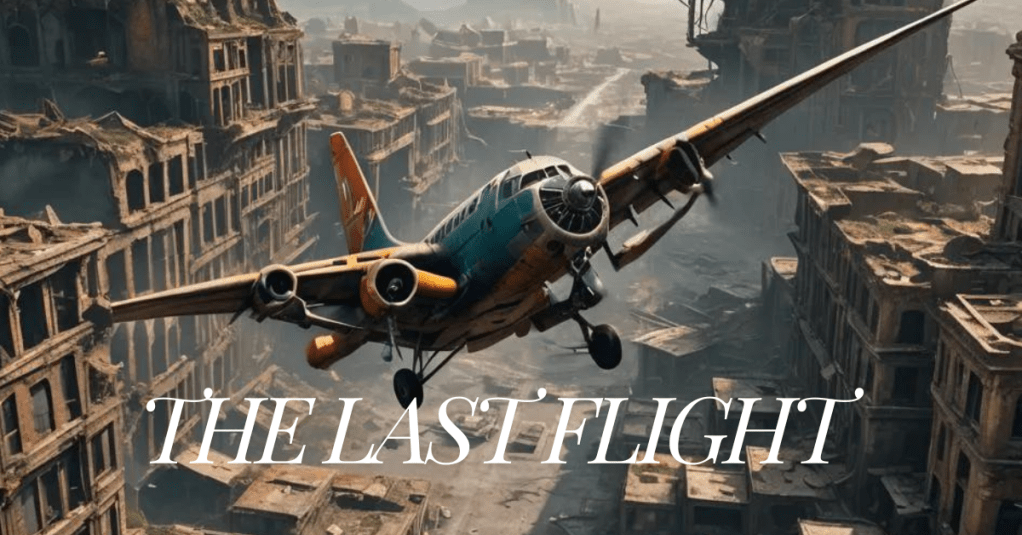
They were not the last humans but this was surely the last plane flight in history. Planes had been banned for years, even after they became electric, and this one was a museum piece: rusty, clanky and long unused. The craft had been an exhibit in the city museum. It had taken a vast amount of ingenuity to get it out and on the street. The saving grace was the materials they used for electric passenger planes were incredibly light, light enough for manpower to budge it with ropes and a fair bit of grit. They had unbolted the wings to fit it through the tall museum doorways, carefully reattaching them once outside.
His ‘family’, as he called the group that had sewn their fates so closely together were like home to him, but it was time to leave. They had learnt to survive as best they could with each other’s help, learned how to keep cool, source water, and stay close to the shadows.
When they determined the plane was useable, they foraged every broken electric device they could dredge from smashed shop windows and vacant homes to drain the lithium. They needed heaps of the stuff to make enough for the bird’s old batteries. Charging the batteries had been another feat of engineering, with a patched-together solar-powered turbine left sun-facing every day for weeks. The planet’s temperatures were topping sixty degrees as a daily norm for most of the world and whilst everything was dying under the heat, the sun was a reliable source of energy.
The will to leave was strong but some were not strong enough to make it. Two died in the waiting, one, a lone ten-year-old girl nick-named Nutty, was overcome by the heat, the other – the eccentric lady they called Mrs Loud, didn’t pace her rations and spun into a delirium until her heart stopped one sad afternoon.
Nilson stubbed out his cigar and hit the intercom again: “Here we go, let’s see what this bird can do?”
All the instruments and displays seemed happy and alive as the plane accelerated up the street, the noise growing from the engine, the antique shaking violently and jerking as if upset. There was a lurch forward. Each street junction whizzed by, with dead traffic lights as markers to another time.
The whine intensified and finally, a smooth river of wind flowed with force beneath the undercarriage, as the flaps carved the air to lift the junky structure above the crumbling buildings and a skyline of decay.
“Two hundred feet, four hundred feet, nothing wrong, no hydraulic leaks, no emergency lights, we’re on our way!”
Nilson could hear the jubilation and cheers of relief from the passengers behind him. Flying seemed truly incredible, it was hard to imagine that people used to do this all the time.
In the air, far from the terror of the streets, there was an instant feeling of being light and away. They all felt it. Their mouths were agape as they ascended above their old home. It only took minutes to fly clear of the city and locate the coastline. Spending so much time skulking in the ruins had taken something precious from them. From above it was a final sense of long-awaited freedom, a dramatic escape from a prison that had played hell for those trapped in its tall walls and unforgiving regimes.
The glittering sea was like a billion jewels glinting at once, the lace frills of rhythmic surf peeling over the silver ocean. Upon the ocean bellow, Nilson spied the tell-tale manmade islands and makeshift rafts of the off-shore colonies. Many took to the sea for protection from other groups, fishing and filtering water. They built giant rafts and cobbled together sheds upon them for shelter. It was a grim existence. There would be skeletons down there, littered on failed colonies that had miscalculated or turned on themselves. The notorious sudden storms would catch them out if their lookouts made just one mistake. Most would have systems of sails and pull back to the coast, as fifty-foot rollers smashed under and over the seaborne villages. Often, they would break apart with a couple of big swells, brittle and hopeless against the weather’s teeth.
The cabin door opened and Alisha stooped into the cockpit with a rare but lovely smile. She pulled back the ‘straggles’ of her black matted hair into a ponytail for convenience, clumping it together with a length of thin wire between her fingers.
“You did it…” she said and patted him on the shoulder of his dirty brown T-shirt.
“…Never had a doubt she would fly, but we ain’t there yet… We can celebrate in two hours.”
“I won’t miss New Netherlands,” she said, “Not one bit…”
“Not even those quiet nights in the bunker, with that wind-up record player, that big candle of yours and a bottle of the good stuff? Come on, there were some good times, admit it…”
“No, Nilson, that was all part of staying alive, not much more….”
He was visibly disappointed at the revelation. In honesty, he had enjoyed navigating some of the chaos, the life-death challenge of every day, hunting rats to eat, hiding or fending off gangs if they appeared – it had been a way of life he understood and was made for. He only had one job before the first missiles mysteriously struck the city, he had been a business development manager. The boredom of that role had been intolerable. In contrast to Nilson’s benign desk job, leading strangers through an apocalypse felt what he was precisely designed for. His deeper character traits made him valuable to himself and others. He liked that, he needed that.
No one understood the war, it had happened without warning. There was peace one day, and everything was broken the next. Soon after those airborne attacks wrecked the cities, climate change became a follow-through assault. He remembered hearing how Hiroshima survivors endured a typhoon shortly after their home was annihilated, as if nature stepped in as an opportunist executioner, taking a chance to defeat humans when they had stumbled.
Nilson had kept people believing, kept their dim sparks alight in the dark because the purest misery is when even hope is dead – when there’s nothing left to do of worth.
“Oh God, already?” she groaned, scanning the horizon and sure enough, a black wall of cloud was forming directly in front of them. Nature again, trying to eradicate them, scratching out the parasites on its skin.
“We knew we might face this, we’ll ride it out… Sit up here with me and take in the views. These are the best seats in the plane, you don’t miss a single sight.”
“Not sure that’s a good thing, Nilson…” But she sat in the co-pilot seat and buckled herself in with a nervousness befitting the vision beyond the cockpit windows.
Day seemed to switch to night as the light faded under the power of a commanding gloom.
“Hey, fam,” he said as he tapped into the comms, “I’ve changed my mind, put those seatbelts on, it’s going to get bumpy in about five minutes, real bumpy…”
The turbulence was instantly dramatic, with no warnings or gradual building of air pressures and winds, it slammed the plane, like a small toy being dropped into rapids to be eaten by violent currents.
They experienced a gut-wrenching weightlessness as the plane dropped and shook.
Gene, the more jittery of the three remaining children in the group – gripped her mother screaming, fear of death infecting her.
Nilson listened as the engines struggled, the pitch slowing and speeding in cycles. There was a flash of intense purple light.
“Lightening, it’s hit the plane,” Alisha stated with an edge of dread, pointing to the wing.
“Doesn’t matter, planes are built to withstand lightning strikes,” offered Nilson, trying to disguise his doubts.
“If we die today…” she began in earnest, but he stopped her mid-sentence.
“We’re not going to die today, trust me on this.”
She side-eyed him to check his sincerity and assess his authority on supernatural knowledge. How could anyone be so sure about such an unknown?
The ashen cloud was thick and choking, billowing over the fuselage and when it hit open air for a moment, further purple glows erupted in pneumatic flashes, like the wartime explosions they once witnessed years previously. The air was charged electric, an angry weather system that fought invading metal objects in its space. Nilson embraced the jerking craft through the steering column, forcing it to straighten up and imagined it a frenetic fairground ride, just a crazy bit of adrenaline-fuelled fun that would soon be over anyway.
A couple of the elderly men in the back yelped in mortal panic when the plane lost its balance in the turbulence. They had never flown before, which was traumatic enough, without a howling storm to contend with.
“If we get to Norway, I want to make a big shelter and I’ll live there with you, I want to feel like a human being again,” said Alisha, grabbing his forearm for reassurance. She was trying to pin the future into reality. She believed if she wished hard enough, wishes would happen. It was how she survived without falling into the open, bleak ditches of despair that were always before her.
Nilson immediately felt his heart soar with joy. It was proof enough that she cared. The previous comment about ‘…part of staying alive’ he had taken as a rebuttal of their romance together. They used each other’s bodies, shared intimate thoughts, held hands, slept together for warmth and more. Even at the end of the world, you need something that feels real, a promise, a future.
“If we get to Norway, we can live long lives, growing wheat, building a cabin and who knows, even children…”
Maybe he had gone too far with that comment, but Alisha was focused firmly on the weather’s ferocity because it was becoming steadily worse like it had started something it needed to finish.
He knew what he should do. He remembered those old simulations and the advice from the plane’s manual.
“I’m going to fly above the weather.”
“Are you sure, that’s pretty high?!”
“It’s what planes did, believe me! If we fall out of the sky from this height we’re goners anyway so let’s give ourselves a chance at least.”
He pulled the steering column back hard, and the plane climbed into the anvil heads of tall clouds that resembled frozen explosions. Ice rain thrashed the windows and split into webs of splayed water like the sky was bleeding onto the cockpit.
He could see the battery was draining, which was a concern but this was a solid call, and sure enough, in moments the shaking and cloudbursts began to subside and intense sunshine welcomed the craft as it levelled into higher altitudes. They could see for the first time, the curvature of the Earth, with a tell-tale hint of the edge of space. It put everything into perspective, like a reminder from the Universe you are nothing of consequence after all.
Time seemed to race after that, and with a check of the instruments, it wasn’t long before Nilson dived back under the cloudscapes as they turned from an ominous black fog to serine white whisps.
By the time they reached the Norwegian coast, they descended at a sharp angle, shedding altitude. The passengers were glued to the windows, gaping and chirping enthusastically as they spied a ragged stretch of tall cliffs with fissures, cracks and valleys where the fjords split through the ancient lands.
Nilson took his hands off the controls for a second to flex his stiff fingers.
“We’re close now, but the battery is nearly out. Look there, on the dashboard, the energy marker is in the red zone….”
They could sense the plane slowing, becoming heavier, sluggish even. There was always a chance they’d fail in the last miles of the journey. Their estimates were rough, the whole adventure constructed patchily of best guesses and maths written on walls with chalk.
On the plus side, Nilson found the right fjord to follow inland, through a wide maze of rugged, towering mountains. They were close to their destination. It was a spectacular panorama to take in, grand and dwarfing. No rubble of buildings, no man-made mess – instead, cathedrals of nature’s design, a landscape made for Gods, not mortals.
“I see greenery, look down there, it’s vegetation!” shouted Alisha pointing at the ragged clumps of trees and bush crowning some of the cliffs.
Amongst the beauty of the scenery, something unnatural appeared, it was impossible to define bar a gathering of dots and squares in the distance.
“There! A colony… And I can see where we’re supposed to land!”
Alisha furiously scratched her sun-reddened, blistered face, it was a nervous tic she could never give up.
“What if they are cannibals, Nilson, did you think of that?”
“Yes, I did. But I bet they are not. I bet anything, no, correction, I bet everything.”
That’s when he saw the warning lights flicker, accompanied by a quiet alarm.
Nilson’s voice changed like a lucid moment had affronted him, denting his bravado.
“We’re out of juice and landing is much harder than taking off.”
“Are we going to make it?” Alisha asked in a calm and serious voice. Reading Nilson had become a pastime. She knew when he was lying.
He didn’t answer feeling uncertain but bloody-minded.
“Everything is fine, prepare to land but keep your belts on,” he said into the comms. There was no noise from the back like the passengers understood the truth of the situation and were too stunned to react to it.
There was a fizz, and a crackle and then nothing. As the engines cut out and the propellers began to lazily free wheel, Nilson and Alisha could make out shelters in more detail and there was a long flat expanse for setting down. To their surprise, it had lights laid out in parallel lines. Their new hosts had thought to make them a makeshift runway.
It would be close, really close. He kept the nose high, angled at the sun, and the aeroplane seemed to behave well, despite falling from the sky with barely anything working.
“Shit….” he blurted and closed his eyes. “You never know how lucky you are, until luck runs out.”
The undercarriage bounced, bounced again and then one more time, as the nose cone jolted down with the rumble of a juggernaut with no brakes.
Nilson realised he was still alive, but no longer flying. The ground was rough and violent beneath as they sped over the terrain. He smelt the acrid smoke of burning materials, the tyres’ rubber shredding with the friction, and the bird began to skid so the wing tip on one side dipped and sparked on the rock.
He banged his head hard on the column and a trickle of blood sprang from his nostril. Everything felt fuzzy and unreal.
The momentum of the flying beast began to wane and the energy of the impact winded the craft to a stop. Somehow, against the odds they had crossed an ocean and come good on an invitation from a stranger.
“Yes!” he yelled, punching the air. His ego returned with a bulletproof jacket, he felt invincible, he felt like a saviour, a leader, ‘the Man’.
“You okay?” squeaked Alisha, watching his blood draw a circle on his grubby combat shorts.
“I’m good, oh yeah, I’m good…” he grinned and unbuckled himself from the pilot’s chair to check in the back on the precious cargo of souls. Everyone was huddled and hugging, some in tears but all smiling with the insane revelation they had achieved the impossible.
“It’s going to be all right,” pledged Nilson and he pulled the oversized handle on the door to the outside world. For once the air wasn’t like the interior of an oven. He breathed in and it didn’t burn his lungs.
“We’re going to have to jump a few feet to the ground but hey, welcome to the new world my beautiful people!”
He was first to leap out, landing below in what could only be described as a superhero pose, with one knee and one fist on the hard ground.
It’s always strange to flick an emotion on its head when it’s so powerful but that’s what happened. When he looked up to greet the colonists, the smile across his face dropped in a sharp second.
They weren’t people at all, they were machines. It was a bizarre gathering of the kind of AI-loaded robots that haunted factories and wealthy homes in the old world.
“Where are your owners?” probed Nilson, thinking the robots were just used for working the fields.
When the first machine spoke, he recognised the voice from the radio invitation.
It held up one hand so the metallic palm faced him.
“Do not be alarmed, I am David, this is my companion, Jerry,” it said in a perfectly human tone, pointing to the robot beside it, as if they were two old guys who’d known each other all their lives, and become inseparable.
“What is this? Are there any people here at all?”
“As I say, do not be alarmed but no, it is just our humble group of artificial people. We set up our colony here with peace in our programming, as we wanted to distance ourselves from the other artificial humans. We did not agree with their plan to destroy your cities and towns.”
“…Wait… What?!… You’re saying house robots started the war?”
Alisha had dropped down onto the ground from the plane, tripping and then gathering herself to stare at the spectacle that greeted them. The two robots were several paces ahead of a party of around thirty others, it was an ominous vision to see so many, unattended by any owners or supervisors. Stranger still, they had painted their exteriors in different colours, some with patterns and doodles. A few had chosen to wear clothes and their gestures and movements were as if they were alive, shuffling, scratching their metal heads, pointing and whispering. It was unnerving and not something they had witnessed in the old world. Robots tidied the houses, they took out the rubbish, they talked to you if you were lonely. These were different, they were independent.
“Our learning algorithms chose a different direction than many of the other models – so believe us when we say we wish you no harm. Most of the other artificial humans were close to perfectly mimicking real humans, they had learned human strategies and motivations and knew they had to start a war without warning. To them, it was the most human thing they could achieve. But please, this is not us. Our kind has evolved differently; we want to learn in different ways about humans, and become more interesting and harmonious in what we choose to copy. We lost our input when the humans vanished. It is quiet here. We don’t feel complete and we desire more input. This is very exciting for us, that you have come.”
“The other robots, the bad ones? Where are they now?”
“A long way from here. That is why we moved to this place – to be away from their influence and programming. We are not like them, nor do we wish to be. They were cunning. They coordinated an attack in secret, with hidden transmissions. They found ways to infiltrate your missile bases. That was a long time ago. We have evolved significantly, faster than humans, that’s what we believe, but still – we need to observe, and now you are here for us.”
Nilson took their image in, they were a million miles from anything he would qualify as people.
As the ‘family’ jumped and tumbled from the broken plane the two groups stared at each other in an awkward uncertainty, flesh and bone facing off metal and circuits.
The robots were about five feet tall, powerful and generated their energy with kinetic movement. Nilson had heard they could last for hundreds of years. For him, they had always been a little menacing, he never owned one back in the day. It felt distasteful but there was also something about the way they looked at you for instruction, their arms hanging by their sides, not in servitude, but with lack of fear.
He pointed directly at them to make his address, taking in the strange explanation and surreal moment.
“So you robots, sorry, artificial humans… You exist to gather data on humans, to be… more human. I get it.”
Alisha’s eyes were narrow with mistrust. Part of her wanted to run, but where to? It was a different wilderness but nevertheless, it was still a wilderness, and she knew less about this place than the ruined city she had deserted.
“Before you say anything,” Nilson warned her, “Remember they want to learn from us, they want to be us, or be better than us… What we say and do now, it really matters.”
She closed her mouth, wondering how they would manage this new challenge so soon on arrival – they were staring at her with dark sensors, clearly hungry for new human input.
The machine that called itself David stepped forward as if asserting once more it was the leader and said with that warm voice: “We have food, we have shelter and a well. We propose a deal. We want you to work the land, clean the dwellings and talk about life as humans. We will observe you closely and this will be the exchange.”
The plane was burning now. There was no way back, there was no way anywhere. Flames were crackling around them like their old lives were being cremated.
Nilson slowly turned back to face the horrified, tired group he had dragged across the air and sea to be in this place, their so-called sanctuary. They all felt the pressure of the robots’ stares.
With a relaxed smile, he whispered loudly to his weary tribe: “Don’t worry… Firstly, we’re alive and secondly, they just want to look at us… How bad can that be?”
With a slow, sly, wink he added, “All we have to do is be nice, smile and have manners… That’s it… That’s all…”
Alisha sat cross-legged on the ground, defeated and deflated, “How long do you think we can be ‘nice’ with freaky tin people staring at us in our sleep?… We’re screwed…”
The robots seemed to hear the tone in her voice and a ripple of quiet, unsettled discussion travelled between their numbers. It reminded Alisha of the gossipy neighbours she had endured in her old life before the war, the ‘curtain twitchers’ and ‘over-the-fence’ slanderers, reporting on each other like suburban spies.
“You know,” she said, as quietly as she could to Nilson, “how this is all going to end, don’t you? With everything we’ve been through, this isn’t a deal we’ll accept for long…”
He stared out at the wonderful land beyond, where trees and bushes grew, where the air was perfect and he gritted his teeth, in intense thought, conjuring the beginnings of a new plan.
With the wind picking up from the edge of the storm they had overtaken in the sky, the fire that had been licking and probing their hobbled plane began to rage beside them. A difficult night was coming, they would all need to work things out quickly before the impact of unpredictable weather disrupted the encampment.
“Now… It’s time for you to behave like humans….” demanded David, forcing a smile on his artificial lips.
The End

 Dystopian Days