

“It’s happening…” she said, her ear pressed against the phone as if to protect her. She turned and her blue eyes were vulnerable. I hadn’t seen them like that since the birth of Emma. Even when we had escaped Tenement City, she had been resolute and defiant. It was like she was realising something too hard to believe when the warning finally came. Like a series of signal fires, we had a network alerting us and others like us of the hordes gathering on the horizon. I had a flash of a memory, the white, natural smile Milly had gifted me on our wedding day. My mother and father, who have since passed, were so proud to see us igniting some love in the world with our union.
I turned to glare at the living room, our beaten-up two-seater sofa with the twin indents and the torn cushions, the dusty beige desktop lamp we rescued from the tip, and the old overread books – all free from the phonebox book exchange in the sleepy coastal town of Yorkton. We had made something here, it was home, it didn’t matter that it wasn’t much, it was enough for us.
Back in the city, when the fires started to flare on the streets and the first of the ‘monsters’ began to hurt people, we had owned a three-floored townhouse in the West End. I had a nice car, I had healthcare and smart clothes. I think in some way that made me more of a target because I had a certain look, a look of someone who was very much on the wrong side, the young side, of 50, of 40, of 30. I was not long evolved from university. People were living till 140 now, it had all happened in a small bloom of time, the miracle drug they called ‘Revitalise’, that reverses ageing in cells. The side effects weren’t obvious at first, after all, a lot of older people were racist, mean and generally disliked the youth, which was standard and tolerated, no, accepted. When their muscles began to grow, when their faces began to change, their minds also became supercharged in loathing. Even when there was no hate to begin with, it seemed to bloom after the drug was flowing in the bloodstream. It twisted a screw of mistrust and resentment to a tautness that had to snap. The fact was that there were more elderly people in the world today than any other age demographic. They came out of their houses and offices, and they began to hunt, increasingly, instinctually, in lurching packs. The resistance was strong, but they seemed to have a sense of how to overcome their younger counterparts. Many of the middle-aged sided with them for security but anyone under 25 was prey and they would often come at night. They even had a name for the young, ‘limpets’, as if young people were ugly animals clinging to a rock they had not earned the right to own.
I noticed signs of it first at work, before the packs roamed and the blood was spilled.
We watched the live feed on NewsCatch, of Central Park on the wall-mounted TV in the reception at the office. A guy, clearly high on Revitalise, was chanting ‘Get them out, get them out’ to a cheering crowd. I had said to my pillar-like boss, ‘It’s not him you need to be afraid of, it’s the mob that follows him…’ and I’ll never forget what he said, his eyes cold and condemning, he turned with genuine anger, and raising his voice he yelled: ‘Did I ask your opinion? You’re too young to understand anything!’
Two weeks later, a grown man spat on Emma who was curled in her sling around my wife’s shoulders, and I grabbed him by the arm. In seconds I was surrounded, by similar old people, who were unusually strong, they were hitting me, pushing me, and threatening to kill me. The biggest giveaway they had the drug in their veins was their eyes, which were black and soulless like their pupils had grown so large they had overrun the balance of colour. God only knows how they saw the world.
The city turned ugly quickly. It felt like it was falling to a stealth invasion, driven by a pure, high-octane, full, rich flavour of hatred.
There were burning cars, kicked-to-death pets, and crosses daubed in red paint on selected doors. The time came and we just knew – we packed two suitcases and left in the night. I dared not take my new SUV, so I opted to steal an abandoned pickup truck near where we lived, after a riot flushed through our street. On the way out at the city limits, I feverishly withdrew cash at an ATM – before hitting the backroads with darkness as a shield.
Yorkton didn’t have many people and they were quiet, the only pharmacy didn’t stock much in terms of drugs beyond painkillers and indigestion medicines and not many of the old here used the internet to buy anything. It was a bubble of safety.
We listened to the waves bashing against the sea wall at night, the territorial gulls screaming at each other and the fierce winds that had been accelerated by the flat expanse of the ocean. We had a huge respect for nature, nature was always right – it was a delusion to imagine we could put it in a box and hold it for our keepsake. But nature came in many guises, and one of them was people. People I learned were more a brutal force than any hurricane or earthquake because people were truly relentless.
We knew what to do, we just didn’t want to believe it was time to run again. Our pre-packed emergency rucksacks were by the front door, my semi-automatic rifle was propped against the fire mantel. I had been gifted it on arrival to the town by the mayor when we made it past the roadblock and were funnelled to the city hall for processing. He was only 29, but he had a background in the Marines as an officer, which counted in times like this. His name was Paul Chance. He looked older and wiser than his years but no one held that against him.
Emma was asleep, so we would need to wake her gently. She would not understand.
The next part of our journey was a last resort. It would mean that Yorkton would be abandoned. There were only two roads to the coastal town and it was clear that they were both compromised. We couldn’t fight an armed mob of the monsters. From the television reports, from a station now in their control, it was apparent they had become more violent, more inventive in their cruelty, and indiscriminate in their murders. They had adopted a grunting noise when they ripped people to pieces in their packs. I wasn’t sure if it was a side-effect of Rivitalise or something they just liked to do, like the grunt of satisfaction after a fulfilling meal.
This was the worst-case scenario, and no one knew if it would work or if it was safe. Yorkton had been a fishing town once, and so there were three boats moored around the corner of a cliff, sheltered in a cave entrance in the sea near the tide line. Twice a day, you could reach them on foot if you were prepared to get waist-high in waves. They were an open secret to most of the town, but it was considered wise not to share the knowledge with many of the elderly there, just in case. It was one of the first things that Paul had told us, whispering it like his words would burn us if spoken too loudly.
Paul was already at the shore when we arrived at the sandy edges where the water lapped. Around him were a small, nervous team of armed men and women. They were guiding people to the boats with their torches, one at a time. We were lucky to get there quickly, it was strictly first come, first served. One boat was already away, bobbing over foam-headed crests, people were crammed aboard unsafely, no life jackets, just their lives and a thin wooden floor between them and the cold depths.
“Glad you three made it,” acknowledged Paul, “… Go to boat three, The Maiden. There is still room but you will need to hold tight to your child. You’ll head out in the direction we talked about once you are beyond the waves. Follow the pilot’s instructions, your life may depend on it. Most of all, keep quiet.”
Behind us, we could see people running. We had to get there first so we ploughed into the sea, our knees just above the water as we turned the corner of the cliff at the edge of the beach. Sure enough, The Maiden was still there, hands were reaching out to us to lift us on board. By this point, we were soaked to the skin. As we crammed into a tight space next to another family, that’s when we heard the first gunshots and screams. Paul’s voice was shouting instructions now, no longer the reassuring quiet voice, as a gunfight had begun. There were quick pops of rounds. Whoever was firing was not concerned with rationing bullets.
The ropes and anchor were dragged aboard and the pilot navigated the little craft out of the cave. People were close behind it, begging the pilot to stop but the mood onboard the desperate vessel had changed to one of practical necessity. It was heartbreaking, it was awful, but we all sensed it was time to go. We were escaping and nothing would stop us. The gunshots became closer, louder, as did the screams. I could hear fear, but also agony. And then – those distinct grunting noises of animals at work, of monsters snarling in satisfaction.
I closed my eyes for a second and decided not to look back but forward, at the others on the boat. To my shock, I noticed one of the people on the boat was an elderly woman, as if she had infiltrated us somehow, but then it was clear, she had never touched Rivitalise. She had white curly hair, a map of wrinkles across her high forehead, and her fingers were twisted with arthritis. She noticed my surprise with those kind, world-weathered eyes, and she gently leaned forward.
“My name is Silvia. It’s okay my dear. We are not all like that you know. People who hate children are not normal – and that drug is evil.”
I saw she was clutching onto a boy’s hand tightly, no doubt the lone guardian of a grandchild in this toxic mess of a world.
I smiled to reassure her back. I would never generalise over age, colour or religion. It was my values and my love that kept me going, they kept me wanting to save what was left.
We were lucky, the others were losing and dying, back in the horror of the beach battle. It must have been a sorry slaughter. When we were far enough away, we could turn and see the red-dotted beach and Yorkton ablaze behind it clearly, in the distance. Fires had lit the place up brightly against the night, a cremation of a sanctuary lost. There were no more screams, just flames and smoke, and shifting packs of human-shaped shadows. You could have mistaken the light and noise for a fairground festival, in long-distant times, the echoes of human sounds, the dance of lights.
The engine throbbed and spluttered as we headed into deep water and the coast became a pencil-thin orange line until it vanished completely. The rolling waves meant vomit, and it was shared liberally amongst the packed boat. No one complained.
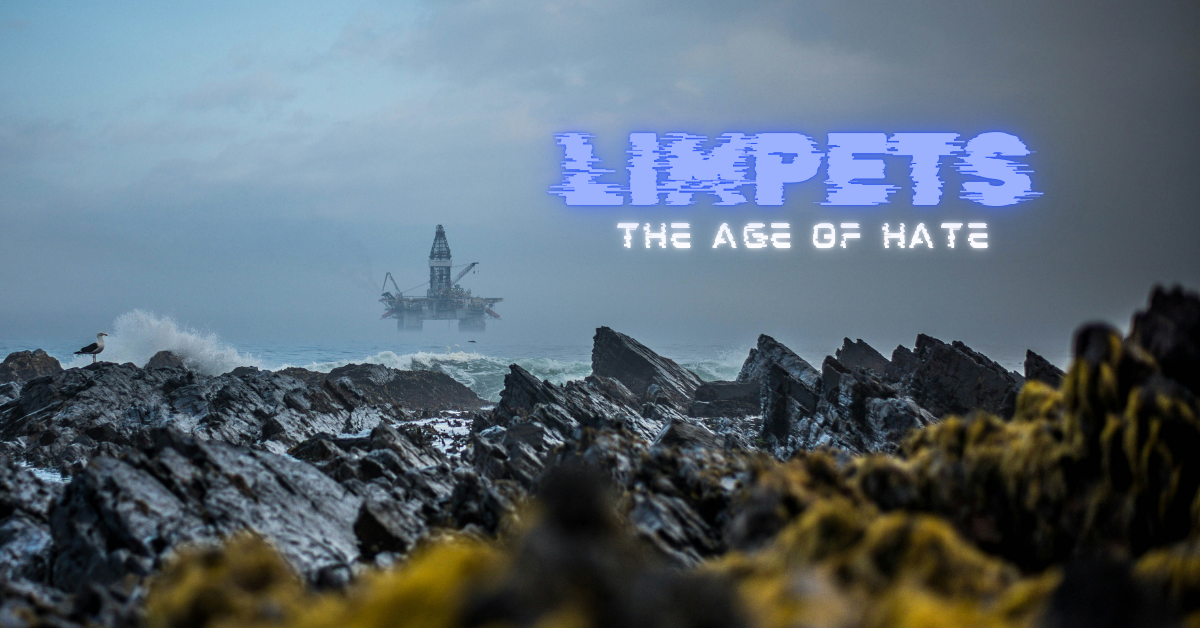
Emma began to murmur and cry, which in turn triggered Milly’s emotions. She had to turn away and look out to sea so the wind tore her tears away. We were heading to what we knew to be called The Gate. It was an oil rig a few miles out to sea, which had been adapted into a last place to exist for those on the run.
The Gate was a tall, wide, lattice of a structure. I could see the chopping relentless propellors of wind turbines on its deck, keeping the lights on in the many rooms inside. A crude ladder to a deck came into view as we neared. I could make out above, an abundance of wire walling there, tall with intermittent poles with barbed hooks supporting it all.
It would be perilous to make it onto the structure. I guessed that’s what made it safe from attack, from the sea at least.
We were shivering now, despite being tightly packed together, the cold from the grey seascape penetrated our bones. I could sense people on the main platform, staring at us. Two boats were already tethered to the structure and had unloaded. Strangely, I thought I saw an arm for a split second in the water, but I was tired and my imagination was firing, filling the spaces.
The pilot turned to us, under his privileged position beneath the tiny cabin roof, and said: “Time to get off… Women and children first. One rung at a time, slow and steady.”
I wasn’t sure if I was pleased or horrified when Emma and Milly were chosen to alight the craft first onto the rusty old ladder. Emma had to grab the metal sides hard. Milly came up behind her, like a failsafe protective wall in case the child lost her grip, and they awkwardly ascended. The first step was the hardest because the ladder rose and dropped with the boat’s motion on the swell. Eventually, somehow, and with many close calls, all the women and children were off, and only a few of us were left, feeling a little better that our loved ones were on deck and we finally had room to move about on the boat.
There was a yell. I could hear some strange commotion up there, above. It unnerved me that the pilot looked unphased, like he had suspected something may occur.
A moment later a shrill cry ruptured the night and Silvia’s body came crashing down from the platform, rejected for her age no doubt. It plummeted into the waves and never surfaced. It was such a sudden escalation we were dumbfounded, and the relief turned to horror in an instant. Who were our saviours, to do this?
I signalled to the other men, to take up their guns and be ready for violence.
The pilot grimaced, and said: “Not a good idea…”
“What do you know?”
“…This is one of the last places on Earth to hide… They are… Protective, and suspicious and they have rules. They will let you be here, but it’s not a free ride, and it’s no holiday… They know me, they don’t know you…”
“What should we do?”
“Give them your guns and show them you are not going to be a problem for them…”
“Come up!” someone shouted up there, concealed in the night.
I slung my rifle over my shoulder and clawed my way up the ladder with a growing sense of dread.
By the time we had all reached the main deck, we could see the groups from the boats were huddled behind wire fences that had been constructed like a large birdcage, and an overbearing crowd of armed teenagers were pointing revolvers at us. I held up one hand in surrender and peeled the gun from my shoulder very slowly, to offer it over. The other men followed my lead.
A wiry, intensely staring teen boy in a blue hoody grabbed my weapon from me, like a bird stealing a grub from a competitor on the wing. He looked pleased with the new toy but there was no gratitude, he pushed me and the others behind the fence with our huddled, shaking families. I realised then, that this was it, the last stop. We had nowhere else to run to.
The wind was turning into a gale and it physically hurt. The weather at sea could change in a blink. I scanned the space we had to live in. There were fishing lines off the side, buckets and a small roof to hide from rain and spray but this was no home. It was in stark contrast to the lit cabins reserved for the original residents, that we could see nearby.
Amongst the escapees I noticed the little boy, staring at the spot in the sea where Silvia had been thrown. I saw the tears but there were no sounds of distress from his throat, or outstretched arms for comfort, like he had expected this, like he had witnessed this behaviour many times before.
I wanted to kneel and tell him, “Don’t worry, it will all be alright.” But I would not lie.
We were all insane, we were all mistrusting of others, and we had all run out of room.
Milly and Emma found my side, and we stared with the boy at the shifting motion of an uncaring ocean. Stealing glances at the children, I wondered if they would be allowed to grow up at all.
The End

 Dystopian Days