
The dead can’t tell you they love you. That’s why I survived. That’s why I crawled like a lizard from the pile of broken grey bricks and through the thick choking smog of destruction dust. The dead are gone; their flesh is waste in the dirt. It smells of disintegration – no flow of blood, no rhythm of air, nor electricity of thoughts. I peered at the severed arms and protruding jagged bones, I sniffed the gore and slid through the slippery syrup-blood. I heard the last words of the lost around me, the cries for family, the screaming for love, the begging for help, and a plea to end the agony. I weaved flat on my belly through the maze of strewn debris, surviving – for you.
I recalled there was a short sequence of unusual sounds. It was like a sharp, excruciatingly loud whistle followed by a deep roar and then a rumble of collapsing walls. I thought of your serene, forgiving smile as the weight of the crashing ceiling descended over me. I needed your forgiveness now.
I had a flash of memory. You were holding me close, that time last summer when we paused from conversation next to the lake, when the sound guy was checking the mics. It was in the golden hour, so the marmalade sun was bathing us in its softer light. I remember your hair lifting with the cool wind’s delicate hands, and the lake water rippling like skin shivering, with the sound of marsh birds carrying on the air around us, announcing our personal moment.
“You are my anchor,” you said, partly as a joke. I had met you at work, and you were indeed ‘my anchor’, like an ancient unmovable rock in the fluid bustle of voices and footsteps and shouts and countdowns till ‘air’. You would ensure there was never any sweat on view for those who watched me, ‘no one wants to see your discomfort’ – that was your way, and that was your job, but lately you seemed irritated, like discomfort was something you could no longer control.
In the overpriced gym with its massive wall-mounted slogans and the chorus of grunts of exertion, I had been looking up through the tallest window because that was where the surprising noises had erupted. I managed to dive at the last moment as that pane of glass shattered – a reflex – and landed on the underside of a nearby unit of large gym equipment. Rubble bounced off it above me, like its frame was protective arms. The scree of masonry made me flinch hard, the impacts filtering smaller projectiles onto my back and head through gaps in the machine’s disc weights and wire tendons. There was so much masonry, like a rainstorm of shards. I had lost one training shoe, and my sock was wet and red, but apart from some painful cuts and bruises, I had been lucky to avoid being crushed. A twisting zig-zag of a tunnel had formed from the line of bench presses and running machines, and it led directly to the street.
Eventually, I found shreds of dusty daylight as I pushed away broken wooden door frame joints, and I guessed, just like the dead, I was drawn toward the light’s power and hope. Light is what all life turns to, to accept its heat, illumination and omniscience. With the light, I saw the dust vent out through a hole to the outside, and I clawed my way onto the pavement beyond.
That is when I realised it was more than natural daylight. The world was on fire. Everything was alight, burning down like Hell had materialised on Earth in some dimensional shift.
This was the New Year, day five.
‘What’s happening!?’ my brain said, letting my lungs shudder out bad air in coughs and grunts.
Everyone who appeared to me in that degraded street was also dazed, confused and bleeding. A surprise attack is just that. There were groans and tears and yells, mashed up in a maelstrom of human chaos, of staggering, concussed zombie-like souls.
You had called me an hour earlier to tell me you would never come back to work, but that you would try to see me soon, despite our awkward, sudden argument and parting, despite our disagreement. I felt like our bond was planted in good soil, and the roots remained even when the stem was severed.
Taking in the damage around me, I realised rules didn’t count when the world was upturned; it was all an illusion, an idea of governance. Safety and security were a lie. It struck me hard, for the first time in my life, that being alive is beautiful and precious.
I had not broken my bones, so I managed to stand defiant of my pain. My ‘T’-shirt and joggers were ripped and streaked with blood from lightning-shaped slices, but I was physically intact.
I had been ignoring the news content lately, like I had been ignoring the police raids on the neighbours’ houses and the street protests in the city. It was just words and pictures, it was just a rhythm of life that was nothing exceptional, nothing I could do about, not without dire consequences to myself and the end of my career. The world outside was other people’s problems; I liked to keep myself to myself, to stay indoors with the front door locked, or be busy at work or pumping iron in the gym, but not many other places. I would read books, keep fit and mind my own business. My doleful-eyed Labrador, Benson, and I were just fine together in our tight cocoon of daily routines. And when I lost you the other day – when you stormed from me with that irritation, I knew it was temporary, it was just frustration, so I kept those embers of our fire alight, enough to keep me warm till our next conversation, where we would inevitably make up. I thrived on routine; it was what I was, what I always would be – my life was one long comfort zone. You were angry at me for that, and I got it. You should know I got it.
I read from the autocue, I speak, and I do what I am told. It is a job. But that last report, that was a line for you, a thick red line.
What was it I said? Something like: “The protesters are insurgents, paid by our state enemies…”
The police sirens began to cut through the shrill, numbing ringing that was already in my head, and coloured lights flickered in my peripheral vision. They had arrived so fast, and they looked prepared, unfazed.
The policemen were masked – that was the first thing I noticed that was different. They had no visible faces, no personalities or features to define them as humans. Their black uniforms were mostly armour and padding, and their guns were advanced, more for warfare than urban enforcement. Their tank-like vehicles rolled into the panorama of degradation as if they were there to arrest the injured. There were no ambulances. It seemed strange, even in this volatile place, like people were simply there to be ordered, and no disorder, for whatever reason, was tolerable – even screaming in the dirt with missing limbs.
I watched them disperse into the fiery remains of what was once normality, realising I was camouflaged, with my matt grey layer over my clothes matching my backdrop of dust settling on rubble. They edged into the debris, not to aid citizens, but to ensure there was a presence of authority, to ensure no one seized an opportunity in the chaos. Brittle, toxic minds were at play from shadowy, hidden command posts. All the buildings around the plaza were in heaps and ruins. Around me was a derelict chain of pits and brick hills. Minutes ago, it had been the heart of the district, where children played chase, mothers shopped, couples kissed on benches, and stern men in suits quaffed wine and made jokes about their work-foes across coffee tables.
The fountains were destroyed, the benches were blown up, and scorched bodies lay everywhere about the upturned tables.
I began to limp toward the traffic lights that had been bent at right angles on the street corner, stuck on red.
“Go to your home now and stay there!” yelled a policeman fiercely, waving the stubby barrel of a machine gun at me. I think he recognised me but couldn’t place where from – a reason perhaps not to shoot me or round me up. I tripped on something as I acknowledged him, and when I looked down, I realised a detached human head was rolling into the gutter.
On the horizon, a sleek grey arrowhead of a fighter plane was screeching low over the city skyline where the financial district’s edifice buildings jutted cloudward. It could not be one of ours, because I saw a missile launch with a spark from its wing, streak across the sky and deliver a towering explosive cloud into a skyscraper, one of the banks’ headquarters. We were being invaded, that was it… But as it tipped its wing to veer off toward the sun, I noticed the flag. I was wrong. And then it hit me. This was a response to an uprising; this was civil war.
Fist-sized gas canisters were popping on the road, spewing curtains of coloured smoke which drifted in purple and orange clouds with the prevailing breeze. I began to hobble quicker, with my painful rolling gait, understanding I was a target more than a victim.
New screams were joining the old. Amongst the pain, there was rage, from the police and from others, the two sides gathering in the road in a crescendo of accusations and threats. And then gunshots, the distinctive sharp explosive rounds, from impatient enforcers charged with hate and orders. Permission was granted: kill on sight, shoot at will.
I broke into a jog, my bruised body reluctant to obey my need to scurry from the scene. As I ran, I fumbled in my joggers to fish out my smartphone. My hand was shaking. The glass screen was smashed into a web, but it was still working. I scrolled away the alert that had appeared, and I saw the text bubble you had sent.
You wrote: ‘I am at Bolthole Café. Are you safe? Can you come?’
The Bolthole was where we used to have breakfast, munching on muffins and laughing about the characters at work, while sipping our black coffee. The café was close to reach.
I managed a thumbs-up emoji and pushed the phone back into my pocket as shots kept ringing out. A bullet whooshed by my ear, and I realised someone was shooting at me. I ducked into an alley and picked up my knees, sprinting past rows of thick plastic industrial bins and a frightened cocker spaniel that was cowering and whimpering over the body of a freshly deceased young man. It reminded me of Benson being alone at the house, and I felt fear rise into my neck, like a crawling stick-insect.
You were my keel, and when you stormed out, I was marooned on the island of my thoughts. They shouted after you, but you kept walking, despite their threats. You were never really afraid. I was not in a good place. I drank Scotch heavily for two nights, the worst substance to drink in remorse. At work, they noticed that my eyes were sunken, my complexion pale, and a new makeup artist was summoned from somewhere; her silence was deafening as she worked. I had risen from my bed at midnight that first night after ‘the moment’, with Benson staring at me from the corner of the bedroom, sobbing as confused dogs do sometimes. You are my friend above all else, and we have only made love twice, but I don’t want to be without you, not at times like this.
I emerged from the alley a little closer to the Bolthole Café on Main Street. I was panting hard, and every muscle still hurt, shocked and shredded.
Why were you there, I thought, at our cafe? Was it because it was our place, our special meeting of minds in the mornings?
When I turned the corner of the street, I realised there were hundreds of people gathered; it was a rallying point. Many were armed, many held dustbin lids as shields, and gripped hammers and pipes as batons. Amongst the jostling throng of protesters, I saw you with your brown hair and your kind eyes, and that ‘T’-shirt, which said, ‘Not in my name’. I waved, and you spotted me straight away, waving me toward you in that way you used to – a demand.
I could feel the concrete through my bloodied sock, and pain seemed to be seeping into me as I moved, growing, spreading, taking over muscles and tendons.
By the time I reached you, I stumbled, and you caught me as I fell forward.
“I was worried,” you said, “…it being your gym day, and I just heard they hit the plaza…”
“They are shooting people, just any people they see,” I informed you.
“This is happening; you have to pick a side now. You can’t hide anymore…”
I heard the words, but I felt my mind become panicked and disoriented.
I told you: “You need to run away with me, this is no place to be…”
You grabbed my arms firmly and looked hard into my eyes – resolute, instructive.
“No, forget everything else, and stand by me… Stand by all of us… You are a celebrity here, and that counts now more than ever. You matter here, you matter…”
Being a news reader was just my job; that was it, report the news, don’t be the news.
“I just read what they give me, it’s not important…”
“You must see. You are the face delivering reality… You matter because they know you’re real…”
You pointed to a nearby electrical goods shop where banks of flat-screen TVs were showing the news in the window. A presenter, an acidic colleague of mine, was interviewing a well-groomed politician in the usual two-chair setup in a grand hotel room, with good lighting and spliced ‘nodding’ shots. The transcription on the subtitles read, ‘People are attacking our law enforcement officers, and they will be held to account.’ There was no mention of the missiles, the plaza, or the random series of executions by the police. They showed an image of a police man, wearing regular police clothes, a light blue shirt and dark blue slacks, holding up his hands defensively as a brick bounced on the pavement nearby. I knew full well that it was unused archive footage; I had seen it before at the studio, but no one outside our profession would know that for sure.
People were now recognising me from the television, patting me on the back, forcing their hands into mine to shake it, so the dust wheeled off.
You hugged me, and from behind your back, one of your companions offered me a placard. It was then that I realised he was the waiter from our café. I took it tentatively and looked around. All their mobile phones were coming out, filming me, a known face, a trusted face, walking amongst them, with them, in body. I felt like I was in a shoal, one that was balling, ready for the imminent attack from a predator.
“Say something,” you whispered, your breath warm in my ear.
“Say what?”
“What you see. Say that…”
I looked up and cleared my throat.
“The police are murdering us…” I uttered, “…They want us dead…”
It was as if I were a viewer, myself.
I heard a unified cry of approval. I had done my job. I was out there on the airwaves now, in the network of the infinite internet, a symbol, a voice – it was my personal report, for you.
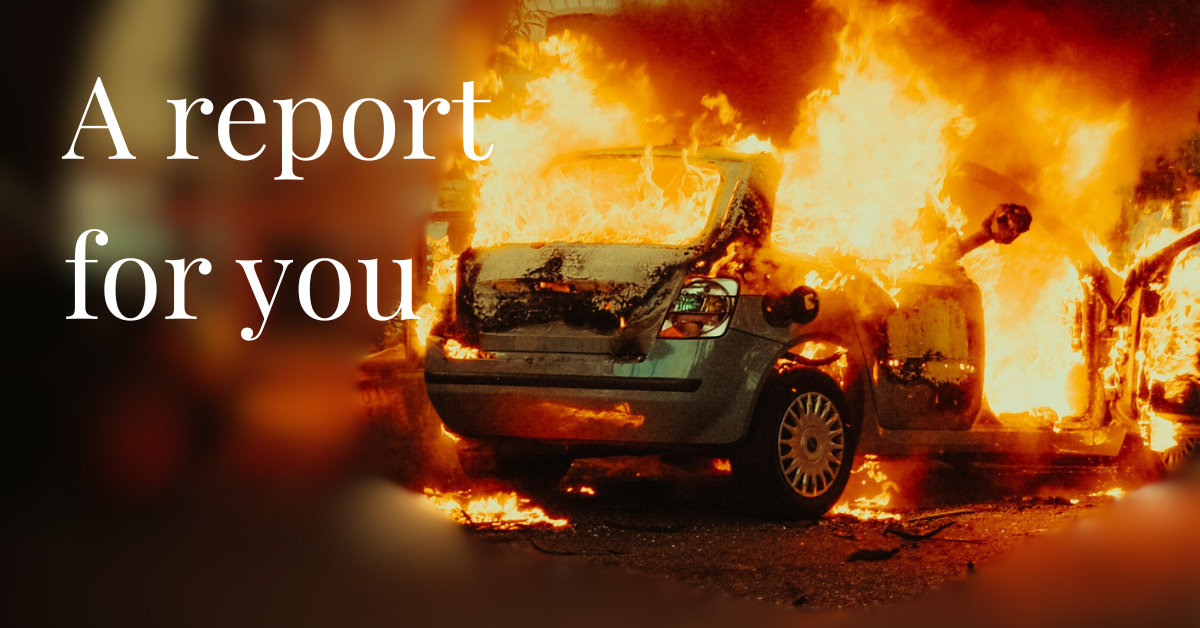
Flames were crackling on the side of the road. Some of the crowd had set fire to a small parked car. They had poured petrol from a canister over the bonnet and tossed a match on it, like the street was their wilderness and they would own it all, and everything in it. It caught and erupted instantly – the flames like the emotions of the people there; erratic, energetic, angry. Chanting began, at first one voice, then ten, then a hundred or more. I watched the flames lurch higher as the voices roared as one, gathering strength and volume.
“I need to get home…” I said.
It was almost an accusation, and you felt it, so you shook your head, making your hair bounce on your shoulders.
“Your house was bombed… Your place, your dog, all gone…”
You spoke so matter-of-factly, like it meant nothing more than the weight of the words. It shocked me.
I stumbled back on my heels in fear.
You kept your grip on my cut arms, like you would never let me go again, or I was your captive.
“But I am here… I won’t leave you again – it’s alright…”
You had steel conviction. You wrapped your arm around me. Above us, darting insectoid drones circled and whined like mosquitoes, watching us closely with little cameras. I could feel the stares from operators in control rooms, tracking our biometrics. At the end of the street, the police oozed into the road with their visors down and their guns raised.
“I didn’t want to be here…” I grumbled earnestly.
“No one wanted to be here like this, but this is our home, this city, and these are your neighbours…”, you said to me. “You have to be here with all of us, or it’s lost.”
I gripped the placard and faced the police line that was forming. They looked emotionless, robotic, evil. Their line looked impenetrable.
“I love you,” I said, and I put my hand on your cheek, so a little blood dripped from my fingers onto the slogan on your chest.
I had never said that to you before. You smiled and buried your head in my chest. I could feel my muscles relax, like part of me knew that this was always going to be the place, and the time, to say that to you.
“You are here, you are with me, and this is our street…”, you growled, your eyes deep and full.
I steadied myself and felt the power of the crowd I was in swell like a storm wave about to break on the shore.
“What if we die?” I asked, a little afraid.
And you replied: “What if they win?”
The End

 Dystopian Days